
The Empty Nest Syndrome
I carefully ease my boat towards a familiar spot on “The Flats”, just as I have done more times than I can remember. The Flats is a renowned smallmouth bass habitat on the east shore of Sturgeon Bay between Pinney County Park boat launch (aka The Quarry) and Sunset Park in Sturgeon Bay. It is a vast expanse of relatively shallow water, mostly less than 15 feet, with little vertical structure except for the occasional glacial boulder. In the summer, schools of smallies roam The Flats feeding. In Spring, bass come into this area in large numbers to spawn. I have been fishing The Flats off and on for over 35 years. The area has not changed much above the water line. A few more large homes and condos along the shore as well as improved launching facilities. However, the water has changed significantly. It is incredibly clear, like looking into a huge bowl of gin. This is due, primarily, to the presence of invasive Zebra mussels (Dreissena polymorpha) and quagga mussels (Dreissena bugensis). These critters feed by filtering small organisms in the water, phytoplankton and zooplankton. The result is water with less suspended matter. Lake Michigan waters are now clearer than the famously transparent waters of Lake Superior. The ecology, particularly the food chain, on the Flats has changed. The increased light penetration has produced more weed masses on the bottom. When I started fishing in Door County, smallmouth fed mostly on minnows, juvenile fish and crawfish. Now they get most of their calories by preying on another invasive, the Round Goby.
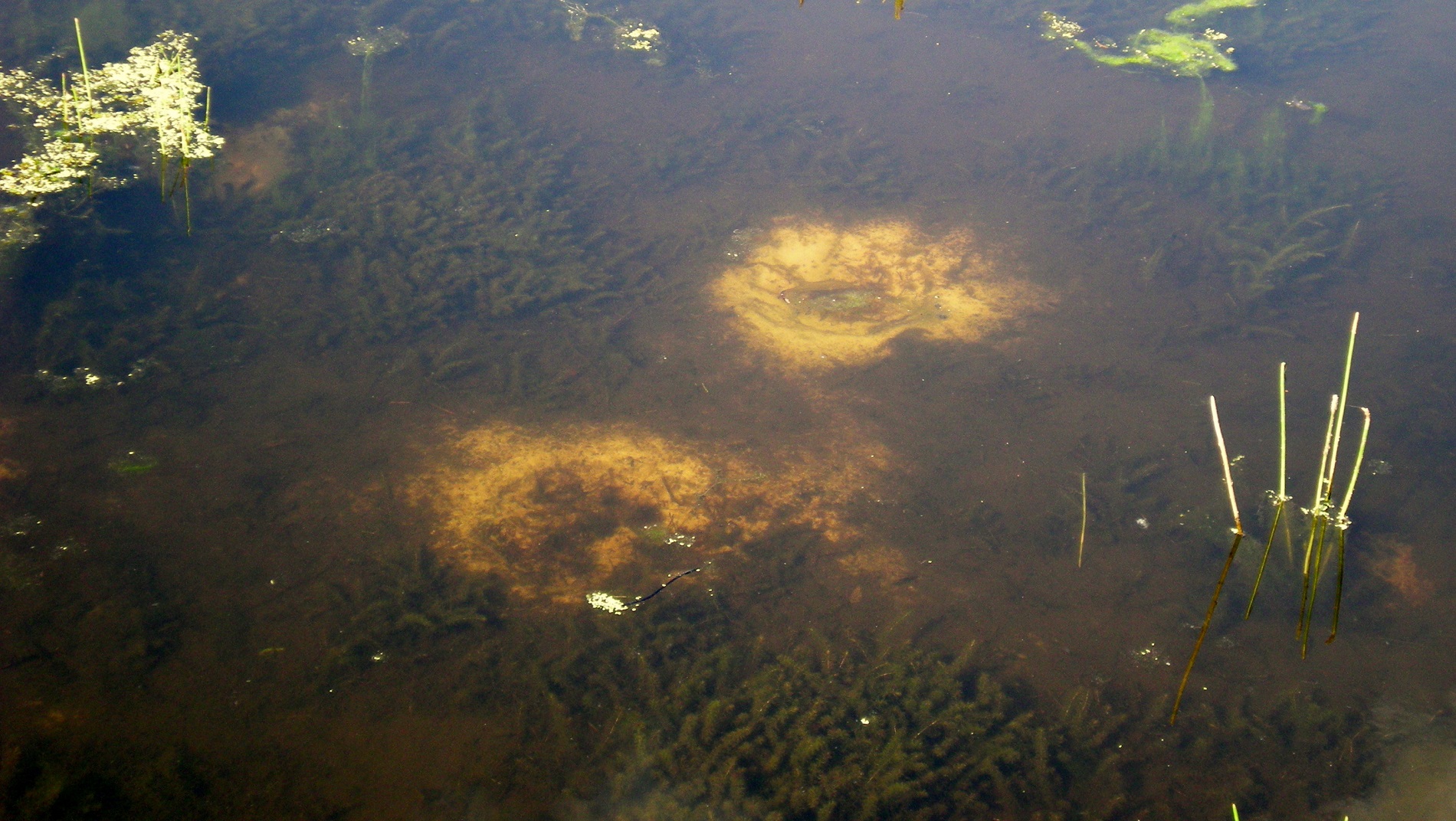
I take in all these changes as I search the water for signs of bass activity. I spot several nice bass swimming near the boat. The clear water allows me to spot fish without difficulty. Of course, the fish can also see the boat and spinning trolling motor prop. Many of the fish I observe are startled and dart away. I ignore them. I am searching for white or lighter-colored patches on the bottom. These patches often indicate bass “beds”. These are locations where male smallmouth bass have painstakingly swept out the bottom debris leaving a suitable spot for a female bass to deposit her eggs. The males arrive well before the females, prepare the nest and wait for a female bass to find him and his nest acceptable. The females are typically off in some nearby deeper locale waiting for the water to warm sufficiently for their eggs to survive. If the male is fortunate enough to attract a female, then spawning occurs. After the eggs are dropped into the nest and fertilized, the female bass swims off for a well-deserved respite. The male bass stays near the bed, defending the vulnerable eggs from any nearby scavengers. These come in the form of smaller fish including perch, bluegills, rock bass and often Round Gobys. If a male bass detects an approaching goby, he will chase it away or just swallow the little bugger. It’s an easy meal while on nest duty. This opens an opportunity for an angler during the pre-spawn and post-spawn periods. Just place a lure that looks to a bass like a goby, and he will likely suck it in. Fish on! Lure manufacturers have come up with countless goby-like lures. I prefer the ones from Z-Man.
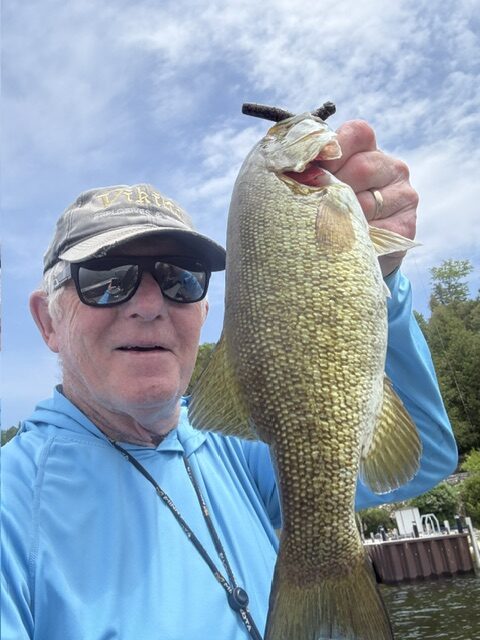
Scanning the water, I catch sight of a distinct white blemish on the darker bottom. I move within a cast length away and swing my rod skyward sending a Green Goby Ned rig in the direction of the target. “Plop!”, the plastic lure lands softly just past the white patch and drops to the bottom. I very slowly finesse the jig close to the suspected nest leaving a little bow of slack in the line to detect the slightest evidence of the bass picking up the lure. Nothing. I jiggle the lure hoping to attract the attention of an attentive male bass. Still nothing. I slowly continue my retrieve and throw out another cast with the same result. Well, not all white spots are bass nests. I move closer to the target and inspect it closely. This is indeed a bass nest. The surrounding debris has been meticulously swept way exposing a clean pebble bottom, the perfect strata for depositing eggs. But no bass is in sight. It is an empty nest. I scan the surrounding water spotting another likely target. Through the clear, rippling water, I can almost convince myself that I can see a dark fish-like object suspended over the nest. I toss another accurate cast toward the nest and positioned the Goby-like piece of plastic near the nest. Nothing. Another empty nest. This scene repeats itself many times over the next hour. Except for a few scurrying bass, all I encounter are empty nests.
Now we could debate the ethics of fishing smallmouth bass on their beds. I have written about this topic in the past. Suffice it to say that this fishing is legal and Wisconsin DNR studies have shown that removing a few bass from their beds has little impact on the smallmouth population in Green Bay. However, it does affect individual fish in a specific area. If a bass is removed from its nest, it will typically return to the nest upon release. Most smallmouth anglers have observed this phenomenon and studies have demonstrated it. In the cold springtime water, the survival rate of returned bass is quite good. So, where are all these bass that should be protecting nests? The answer is all around me. Within sight, I can see at least 15-20 other boats, each occupied with anglers in pursuit of smallmouth bass. Judging by the sleek, fiberglass hulls, shiny powerful outboard motors and the latest electronics on board, these are not your casual weekend anglers. Many are guides with clients, others are professional anglers taking part in one of the many bass tournaments in the early season. Several of the boats are slathered with corporate and sponsor’s logos. What we have here are experienced, serious anglers. They fish hard and thoroughly. They leave no bass unturned. This is the biggest change I have seen over the years. Pressure! (Cue David Bowie.)
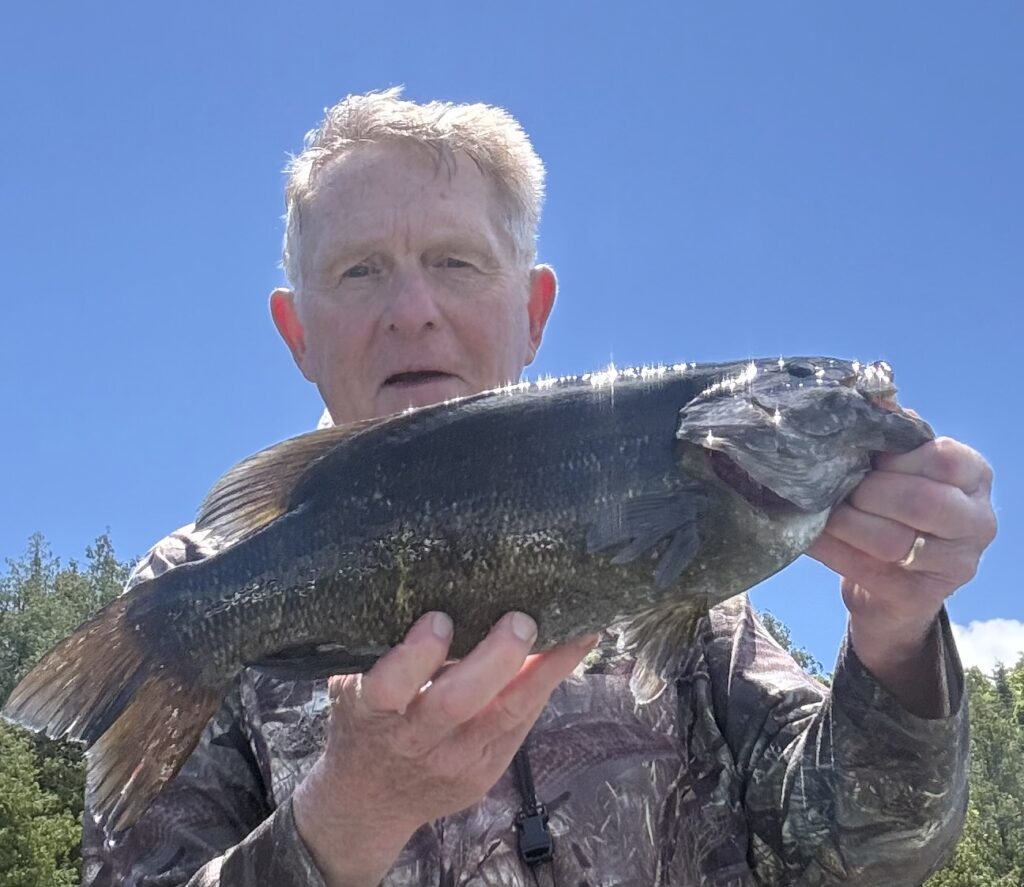
The last several years, I have been catching less smallmouth per outing that I did 20 years ago. And I have the records to prove it. Yet the fish surveys by state and federal agencies indicate strong populations of fish in the Green Bay system. If anything, the bass are growing faster and larger due to the influx of a plentiful, nutritious forage, the Round Goby. I spend more time fishing than I did when I was working for a living and I am surely not a worse angler then I was then. I have better equipment, better electronics and much more experience on the water. So why am I not catching more fish. Pressure is unquestionably one of the factors. I look at it this way; Let’s say there is a particular location on The Flats where, during the course of the day, fifty smallmouth are active and feeding. If I am the only one fishing the area, as was often the case 20 years ago, I’d have a shot at catching all fifty of those fish. I have had many 50+ days. However, if that same area is hit by nine other anglers in addition to me, those fifty fish will be split among the ten anglers. And they will not be split evenly. The first anglers will have a better chance to catch more fish as will the better anglers and those who fish harder and longer. Thus, even though the population of bass remains high, each individual angler will have less opportunity to catch those fish.
The empty nests are evidence of this. Each nest, at one point, had an active male bass guarding it. That fish was caught and released. Catch and released is required prior to July 1st on Green Bay waters. The bass will likely return to the nest if released promptly. But then it gets caught again. And again. And again. Sooner or later the fish will think “screw this” and abandon the nest. A fish can only take so much. This drama gets repeated all over the The Flats resulting in a lot of empty nests. But these fish are not gone. They just move somewhere else. Perhaps next spawning season, they will make their nests in a different area, typically in deeper water. So, this is the other reason I am not catching as many fish as I used to. The fish have changed their patterns. I can’t expect the spots where I caught bass 20 years ago will still hold fish. Too often, I catch myself fishing yesterday’s bite. Or last years.
So, what must be my response to all these changes? There are plenty of smallmouth out there, perhaps more than ever, and the average weight is heavier than ever as indicated by the tournament results. However, their behavior has changed in response to the increased fishing pressure. I have had to adjust my tactics. As a counter to the clear water, I have gone to equally transparent fluorocarbon leaders. I take much longer casts, far enough away that the presence of the boat does not disturb the fish. I choose lures that “match the hatch”. I used to use a lot of small Rapalas, simulating the available forage. Now, I choose baits that emulate a goby moving among the rocks and debris on the bottom. When selecting a spot to fish, I look for an area with the fewest anglers, ideally none. It might be a place I have not fished before. That way, whatever fish I find, I’ll have to myself. Just like the fish, I must adapt to survive.
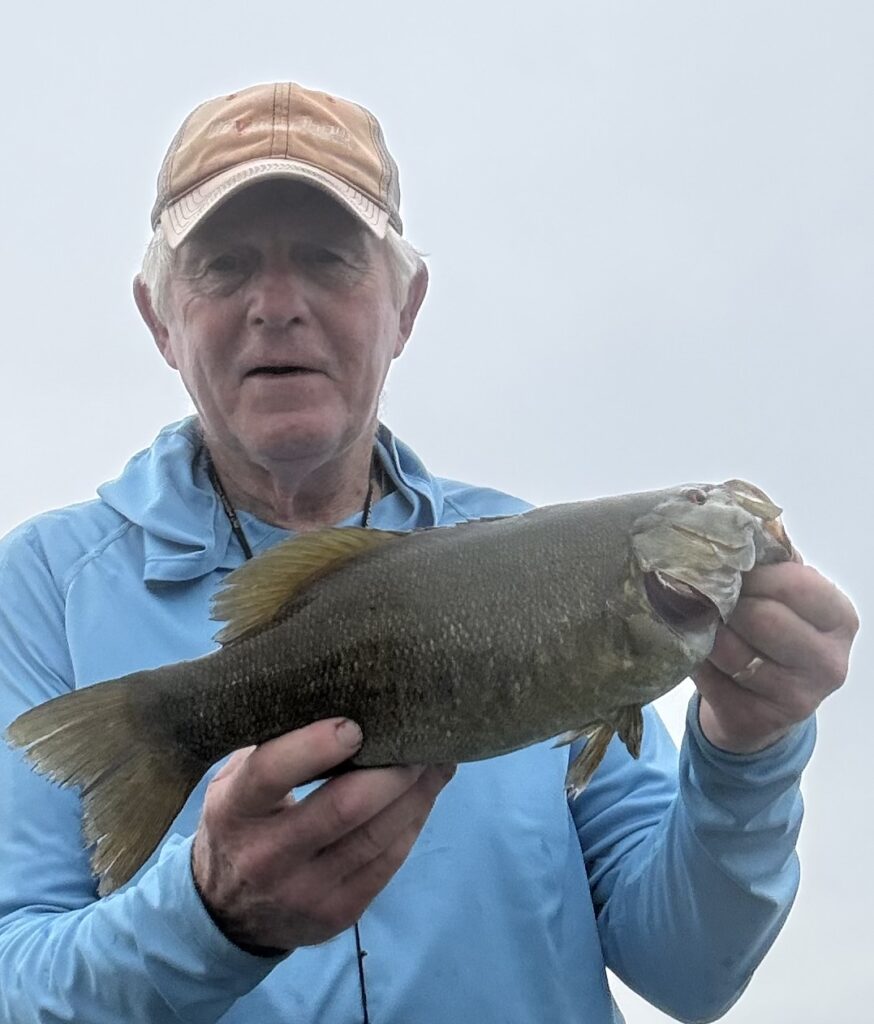
I don’t need to whine about all those other anglers taking “my spot”. I don’t own the lease on the water. I need to be a better angler. Work a little harder, get out a little earlier and be willing to change. If I am not willing to do that, well, I guess I am not going to catch fifty smallmouth today. And that’s alright. Ten feisty bronzebacks is enough fun for anyone. The challenge is in the hunt, or as athletes call it, “the process”. Trust the process and enjoy the journey.
So Long, and Thanks for All the Fish, Bruce
Questions or comments to bsmith733@gmail.com